
Playing Time and Development: How Families Can Assess a Team’s Approach
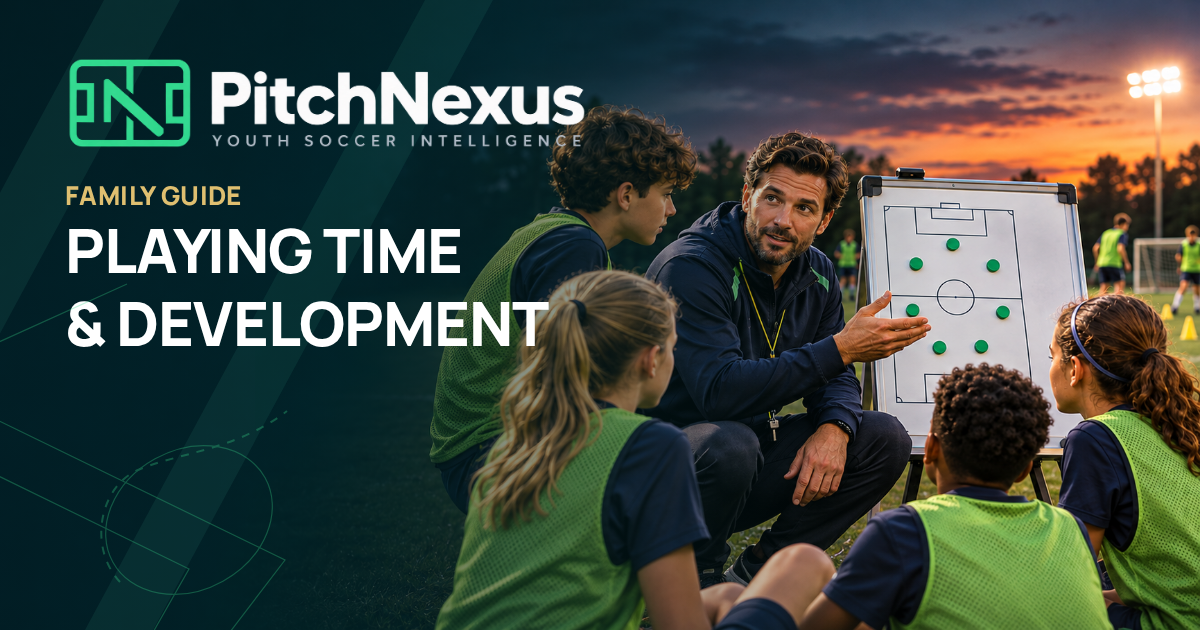
These family tips apply across youth soccer settings. The cited studies come from their stated settings and do not represent every family.
In this article
Playing time is one of the clearest signals families can use to understand a team’s development approach. It is also easy to oversimplify. A single weekend, position, injury or scoreline cannot explain a player’s season. The useful question is whether the coach has a clear plan for helping players learn, contribute and take on new challenges.
This guide offers a practical way to ask about that plan without treating minutes as a promise or a ranking of children.
Ask what development means on this team
Start with the coach’s definition of progress. Does development mean technical repetition, decision-making, defending in different roles, communication, confidence or preparing for the next age group? A credible answer should describe what players work on during training and how coaches give feedback.
Ask how the team balances competition and learning. In a close match, the coach may prioritize a result; in another match, the goal may be to test a new position or build a decision under pressure. That context matters when you review available results on PitchNexus. Match outcomes show what happened, but they do not show every learning objective.
Turn playing-time questions into specific questions
Policies differ by age, competition and club. Instead of asking only, “Will my child start?”, ask:
- How are playing-time decisions made for league matches, tournaments and friendlies?
- What should a player improve to earn more responsibility?
- How are absences, injuries and new positions handled?
- Do players get opportunities in more than one role during the season?
- How will the coach communicate progress and next steps?
The answers should be specific enough that a family can understand the process, while recognizing that no coach can guarantee an identical number of minutes in every match.
Look for a repeatable feedback loop
Development becomes easier to evaluate when the team has a rhythm: observe, give feedback, practice, then revisit. Ask whether players receive individual conversations, written goals or video examples. Ask how often families can discuss progress and who should be contacted when a question comes up.
A useful conversation focuses on behaviors rather than labels. “Scan before receiving” or “recover quickly after losing the ball” gives a player something to practice. “Needs to be better” does not. Families can also ask how the coach measures improvement when a player’s role changes.
Check the fit beyond the lineup
Playing time is part of fit, alongside travel, school, cost, training quality, teammates and the child’s enjoyment. Watch a training session if possible. Notice whether players are active, whether coaches explain decisions and whether mistakes are treated as information. Speak with current families about the ordinary week, while remembering that their experience may not match yours.
For younger players especially, a healthy environment can matter more than a short-term starting role. For older players, families may reasonably ask how the team prepares players for the next level and how competition affects opportunities. The right balance depends on the child’s goals and readiness.
Bring the conversation back to the child
Before accepting a roster place, write down what your child wants to improve this season and what support they need from the adults around them. Revisit those goals after several weeks, not after one difficult match. If the coach can explain the plan, offer actionable feedback and adjust roles thoughtfully, families have useful evidence of a development-minded environment.
PitchNexus can help you review the published schedule, opponents and results for a team. Use that information as context for a conversation with the club. It can show the competitive setting; it cannot predict a child’s minutes or replace a direct discussion with the coach.
Sources
[1] U.S. Soccer, Player Development Initiatives: https://www.ussoccer.com/4v4
[2] Positive Coaching Alliance, youth sports development resources: https://positivecoach.org/resource-zone/
[3] Aspen Institute Project Play, youth sports research: https://projectplay.org/
Comments
Share your thoughts on this story. Comments and your profile name are public. Please keep children’s personal details private.